
Introduction
Most new traders enter the forex market focused on one thing: profit. They study strategies, watch tutorials, and look for that perfect setup that promises big returns. But experienced traders know a different truth. The real key to long-term success in forex is not how much you can earn but how well you can protect what you already have.
This is where risk management comes in. Without it, even the best trading strategy will eventually fail. With it, even an average strategy can deliver consistent results over time.
In this article, we share seven essential risk management rules every forex trader should know and apply.
Rule 1: Never Risk More Than You Can Afford to Lose
This is the golden rule of trading. The forex market is volatile, and even the most carefully planned trade can move against you. Always trade with money you can afford to lose without affecting your daily life or financial responsibilities.
Treat your trading account like a business investment, not your savings account.
Rule 2: Use the 1 to 2 Percent Rule per Trade
Professional traders rarely risk more than 1 to 2 percent of their total account balance on a single trade. This means that even if you have a string of losing trades, your account will still survive and have the capital to recover.
For example, if your account has $5,000, risking 2 percent means you only put $100 at risk on a single position. This approach prevents emotional decisions and helps you stay in the game long term.
Rule 3: Always Use a Stop Loss
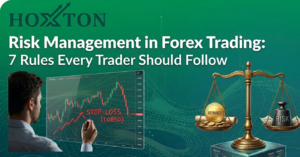
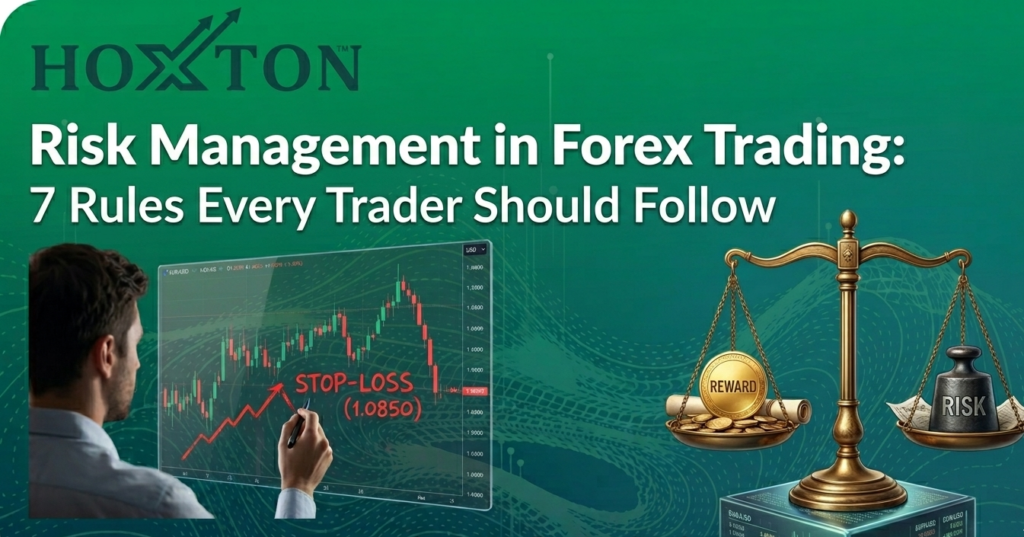
A stop loss is an order that automatically closes your trade once the market moves against you by a set amount. It is your safety net.
Many beginners avoid stop losses because they do not want to “lock in” a loss, hoping the market will turn around. This thinking has wiped out countless trading accounts. A stop loss is not a sign of weakness. It is a sign of discipline.
Place your stop loss based on logic, such as below a recent support level or above a resistance zone, not based on how much money you are willing to lose.
Rule 4: Maintain a Healthy Risk to Reward Ratio
The risk to reward ratio compares how much you are willing to lose against how much you aim to earn on a trade. A healthy ratio is at least 1 to 2, meaning you risk $100 to potentially make $200.
Even if only half of your trades succeed, a 1 to 2 risk to reward ratio still leaves you profitable over time. This is one of the most overlooked yet most powerful concepts in trading.
Rule 5: Avoid Overleveraging
Leverage is one of the most attractive features of forex trading because it allows you to control large positions with a small amount of capital. But it is also one of the most dangerous tools when used carelessly.
While high leverage can multiply your profits, it can also multiply your losses just as fast. Beginners should start with low leverage and only increase it once they fully understand the risks. Always remember that leverage works in both directions.
Rule 6: Do Not Trade Based on Emotions
Fear, greed, revenge, and overconfidence are the four emotions that destroy more trading accounts than any market move ever will. After a big loss, traders often want to “win it back” quickly. After a big win, they often start taking unnecessary risks.
The solution is having a clear trading plan and following it strictly. Decide your entry, stop loss, and target before you place a trade, and stick to those levels. If you find yourself trading impulsively, step away from the screen and take a break.
Rule 7: Keep a Trading Journal
A trading journal is one of the most powerful but underused tools in forex trading. By writing down each trade, including your reasoning, your emotions, and the result, you create a personal record that helps you improve over time.
Patterns you may not notice in real time become clear when you review your journal. You start spotting which strategies work best, which currency pairs suit you, and which mistakes keep repeating.
A simple spreadsheet is enough to start. The discipline of recording trades is what makes the difference.
Why Risk Management Matters More Than Strategy
Many traders chase the perfect strategy, but the truth is that any reasonable strategy can be profitable when combined with strong risk management. Without it, even the most advanced system will eventually break down.
Think of trading as a marathon, not a sprint. The traders who survive and grow over the years are not the ones who took the biggest risks. They are the ones who managed their risk most consistently.
Final Thoughts
Risk management is not the most exciting part of trading, but it is the part that determines whether you stay in the market long enough to succeed. Master these seven rules, apply them consistently, and you will already be ahead of the majority of traders who focus only on profits.
At HoxtonFX, we encourage every trader to build their skills with patience and discipline. Markets will always offer opportunities. The question is whether your account will be there to take advantage of them.
Risk Disclaimer: Trading forex and CFDs involves significant risk and may not be suitable for all investors. You may lose part or all of your invested capital. Always seek independent financial advice before trading.